Mirella
Savee

Create Your First Project
Start adding your projects to your portfolio. Click on "Manage Projects" to get started
For this assignment, I got to choose any designer collection and analyze the runway show. Galliano's collection's theme was 'Freud versus Fetish and he demonstrated this by trying to uncover the unconscious state of mind. My job was to analyze how he captured this theme in his looks as well as how he did so.
Skills:
Overview:
With Galliano using Freud's Psychoanalysis Theory on fetishism, I connected those statements to the garments created. Before looking at the overarching theme, I wanted to depict the garments and form a timeline.
Gaining an understanding of the designer:


Cartwheel Hat
Sinched Waist
Corset
Kitten Heels
Tulle
Ruffled Suit
When looking at the runway show, I kept a running list of what materials and accessories the garments used. I then used those elements to compare and contrast how some garments were similar, and how they might have differed. With keeping a list of the garments, I could go back and refer to what time period the inspiration was drawn from. Galliano's garments represented knowledge from the 17th, 18th, and 19th century fashion, mixing different centuries together.
Finding the underlying meaning
I know the basics of the garments, and the elements that make up the show. I wanted to understand Freud's theory on fetishism. How does Galliano's garments convey this theory?
"I am trying to symbolize what fetishism evokes in the pyschology of clothing."
-John Galliano

Galliano starts the show off with a priest setting the tone as the unconscious dream state he was going for. The priest represents the guilt and psychological tension that mirrors the emotions at the heart of fetishism.
Following the priest, the setting seems to be at a wedding from afar. Taking a closer look, the groom's hands are handcuffed behind him. This new symbolism shows how powerful complex power dynamics are between men and women. This relates to Freud's theory of the boy's fear of female genitalia.
As the show came to an end, these two garments went hand in hand to convey Freud's theory that guilt will always linger. The model wearing the red suit has her hands tied with a scarf, leading to the model behind her. With the model in the white wedding dress holding on to the model wearing red fishnets, this conveys the guilt that will always linger in the back of someone's mind at the root of fetishism.
The heart of fetishism:
power dynamics:
lingering guilt:


connecting cultural and historical garments




Marie antoinette:
Ming-dynasty:
Day of the dead:
This part of my assignment I enjoyed the most. I got to expand my knowledge on how much different historic time periods are key elements when thinking about Freud's Theory, as well as culture.
Glancing over this piece, some might not notice the subtle slash on the model's neck, connecting Marie Antoinette's beheading.
With her story being of public scrutiny and objectification, her story fits in the place for Galliano's Freud versus Fetish runway. This mirrors Freud's idea that fetishism is a psychological- response to fear and powerlessness.
W
Although this look is beautiful, the underlying truth is disturbing. As the model has porcelain-like skin, the arms crossed holding a fan disrupts the consistency, representing not only an uncanny tension, but how details disrupt the overall fantasy.
The first thing that grabbed my attention was how this look resemembeled a puppet doll, every action being controlled.
The lips being taped shut adds to this delusion, that symbolizes the objectification in fetishism. Rather than an autonomous body, it has become a controlled one.
The true symbolism lies in the design. This specific silhouette functions like a psychological armor, which is a way to hide, protect, or even disguise the body.
The colorful material brings back the uncanny emotion Freud talks about that can show up as a trigger. Something human, but not fully.
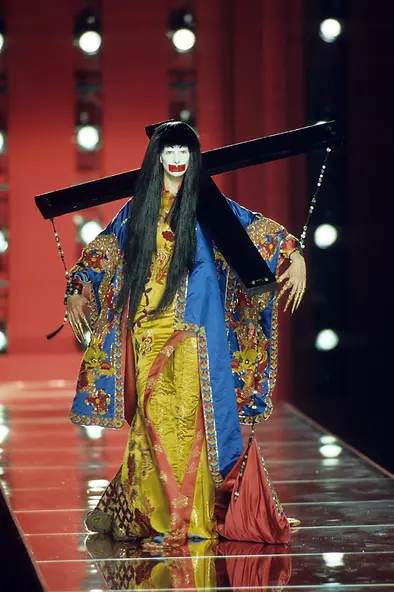
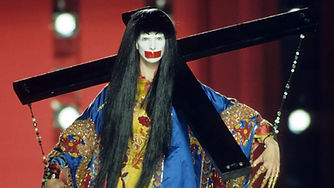
This look challenged me to find what was the hidden meaning, but I soon realized I didn't have to look that hard. Looking closer at the detailing of bones, it then hit me. This look is inspired by the Day of the Dead, which shows the confrontation of morality. Galliano used this culture which symbolizes to mirror Freud's idea that fetishism is a ritual the psyche performs to manage fear.
After figuring out Galliano's main tie to Freud's theory, the mask made it all come together.
The mask represents the need to hide the face, which creates tension. The fetish object is present but not fulfilling its "function", which mirrors Freud's idea of unresolved desire.
Key TAkeaways:
In conclusion, I got to see how Galliano interpreted different theories and symbolism, and I saw it come to life within this collection. I got to expand my knowledge on looking for symbolism in garments, and learned about how motifs and designs can speak louder than words.
Historical & archival referencing
symbolic reading
theoretical application
cultural interpretation
Research literacy
Comparative look analysis
Analysis of a collection: john galliano dior fall 2000
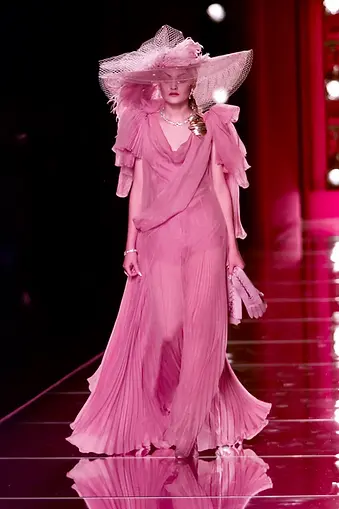

I got to learn about Freud's theory, which I never did a deep dive on, and I was truly fascinated. With Galliano representing such a sophisticated theory, the garments are still wearable for fashion. Although the accessories and make-up is eery in some ways, the underlying garment is still considered fashionable.